we can loop on joy/love/peace to induce the "opposite of a panic attack" and surprisingly it feels better than mdma
and somehow it's super empirically reproducible, too! here's an overview.


note: this is part 2 of a series! links: 1, 2, … (still in progress)
another note: this post is an experimental draft! i think i’m ready to share this version with you guys, but please email me via [corbin at brown dot edu] with ANY questions or feedback, so i can try my best to clear things up!
Some preface: this topic can be unnecessarily confusing!
As I said in the previous blog post, we’re recently seeing a lot of cool nerds get into advanced meditation.1 Some of those nerds hang out online, especially the ones in San Francisco, and somehow I found myself talking with them.
One of the things I kept hearing about were these “deep meditative states” called “jhanas.” That sounded really weird and exotic, especially when I already had some funky preconceived notions of “advanced meditation.” To make it worse, meditators sometimes use funky jargon to explain things; even the word “jhana” itself made it sound really exotic to me!2 So, I didn’t believe them for a long time, and there weren’t many good public resources on how to clearly make sense of this — everything was either a woo traditional explanation, or a practice guide for experienced meditators, or a short blog post describing someone’s retreat experience, or a non-comprehensive FAQ section, etc.
Still, I was really intrigued, so I spent a lot of my free time trying to decipher what the heck they were trying to talk about. Eventually, it became clear to me that these are not magical or exotic at all! In fact, I’d argue that it might be better for a curious bystander/beginner to not even think about them as “advanced meditation,” so that we can do away with any preconceived notions and popular misconceptions. They’re kind of just a cool little mental trick, with effects that are surprisingly empirically reproducible, and also surprisingly profoundly positive.
Now I wanna share that understanding with you guys! (I’m partly writing this blog post so I can finally send my friends something instead of me just rambling to them, haha.)
The approach I’ll take here is similar to how my favorite professor might explain “entropy” or “KL divergence”: not as some spooky abstract thing, but just as... a definition that follows naturally from familiar cases we already understand.
Yes, there are some surprising empirical results, but the core idea is pretty intuitive and perhaps familiar!
(1) It’s pretty reasonable to expect that humans can learn the mental motions to reliably spark a positive emotion — we can obviously do it with negative emotions by simply visualizing a triggering situation, and we can learn how to reliably do the same thing but for positive emotions.
In practice, this can look like visualizing an uncomplicated joyful memory, or cultivating a sense of love or gratitude for something or someone, or just gently smiling, or imagining a puppy or a smiling baby, etc. The positive emotion here is more important to attend to than whatever you choose to spark it.
(2) Then, hopefully it’s not hard to see how (with enough practice) this can develop into a more stable, continuous positive feedback loop. We can obviously create this kind of self-sufficient fire with negative emotions (e.g. rumination, grudges, etc.), and it turns out that we can learn how to do the same thing with positive emotions (bathing in joy, love, peace).
In practice, this can look something like: taking a few minutes to physically relax, then starting a loop of gently re-sparking the positive emotion, relaxing any subtle physical tension, and noticing any mental tension (including distractions) then softening it via welcoming / accepting / loving / embracing / comforting / befriending / listening to / opening up to / hugging / holding / sitting with / forgiving that inner part of yourself; then repeating this whole loop a few times per minute. It’s better to relate to experience more openly with less tension, instead of trying to spam a big happiness button to forcefully change experience. The tiniest emotions are enough to start a feedback loop. With a relaxed mind, the positive feeling will naturally stay continuous (and even grow on its own), like a hockey puck on an ice rink. If any stubborn mental tension exists and doesn’t straightforwardly relax, it can usually be an emotional blockage that needs a bit more attention, like a longer session solely focused on gently untangling your mind as if you’re patiently talking to a group of preschoolers that aren’t getting along.3 Just like befriending other people, the motions of befriending your own mind has a rich landscape of possibilities to try out. And, just like with other people, you can’t command / contrive / force friendship with yourself. Slow is smooth, smooth is fast. Curiosity helps a lot. With enough experimentation and engagement, all of these motions become second-nature over time.
(3) Then, the surprising empirical result (i.e. what we surprisingly observe in advanced meditators) is that with enough stability/continuity of positive emotion, there’s a sort of step jump or inflection point where it grows exponentially, into a profoundly positive state. This is measurable4, not just subjective report, but it’s still kinda hard to believe if you think about it like an exotic meditative state — I think it’s way more believable if we again compare it to the familiar case with negative emotions. We know it’s totally possible to have panic about panic that “takes off” exponentially; we call this a panic attack. It just turns out we can learn how to do a similar thing but for positive emotions; we can learn the skill of having a love attack, a happiness attack, a peace attack. And this is what is called a jhana!
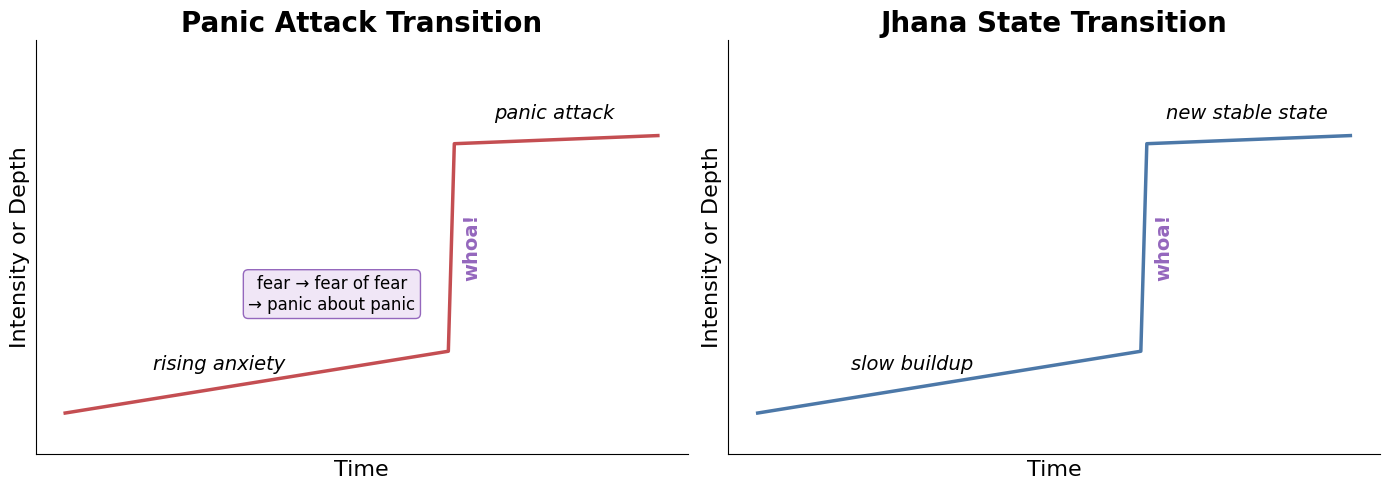
In practice, you have to let this final step happen to you, in some sense. It’s a lot like sneezing or falling to sleep, in the sense that you might initially put in some effort to cultivate the proper conditions, but the final jump happens on its own, the body automatically carries out the final step of process, you don’t have to consciously enact it (in fact, you intervening to try to skip to the end sometimes makes the happiness-feedback-loop less effective, just like when trying to fall asleep).
I want to again emphasize that this phenomenon is not necessarily because of anything mystical, magical, or exotic. It’s just what reproducibly happens when we attend to a positive feeling while the mind is sufficiently relaxed and collected.
And, it turns out that people can get pretty good at this, such that they’re able to reliably self-induce these states after just a few minutes silently going through the preparatory mental motions, or even while walking!
Apparently, there’s 8 kinds of these experiences, and they feel really great!
After lots of “jhana practice”, it becomes evident that these experiences can be sorted into 8 distinct categories. This is kind of a surprising empirical result! One might expect that it would be a fully continuous spectrum, but we instead observe that these profoundly-peaceful-feedback-loops have discrete modes.
In addition, these experiences generally follow a kind of natural progression, such that deepening one kind of experience leads to the next one! Thus, by convention, they’re denoted as jhana 1, jhana 2, and so on, commonly abbreviated as J1, J2, etc.
The first four categories of jhana experiences (denoted J1 to J4) feel really, really, really good. Here are some descriptions from meditators!
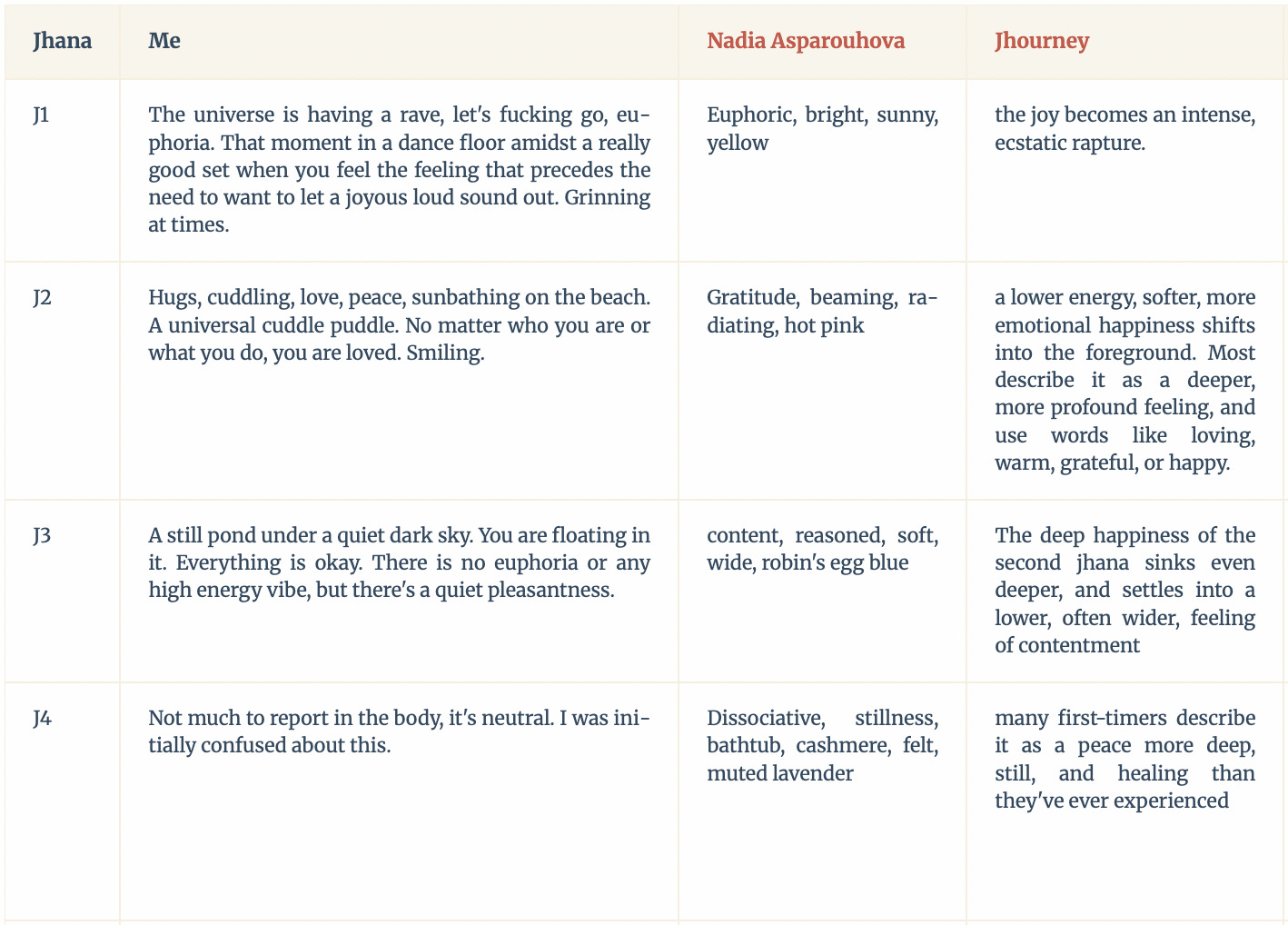
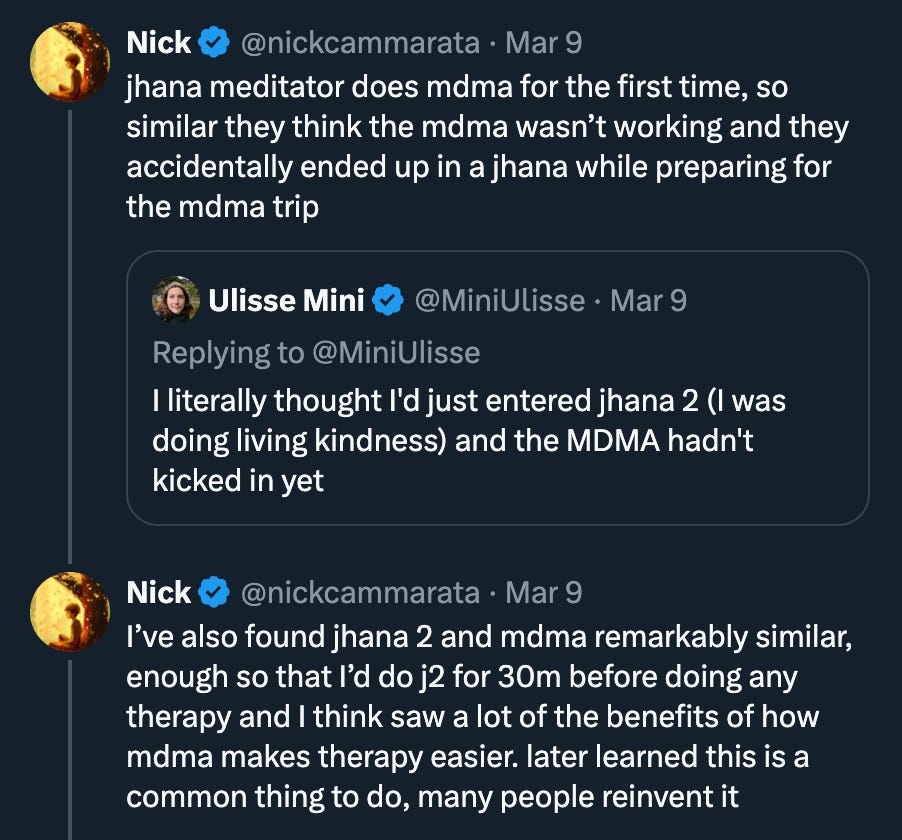
I want to emphasize that these are not just mildly positive experiences; practitioners consistently report feeling the most joy/peace they’ve felt in months or years. In fact, it’s pretty common for meditators to compare J2 and MDMA. For reference, here’s a beautiful quote of the MDMA subjective experience:
The woodpile is so beautiful, about all the joy and beauty that I can stand. I am afraid to turn around and face the mountains, for fear they will overpower me. But I did look, and I am astounded. Everyone must get to experience a profound state like this.
I feel totally peaceful. I have lived all my life to get here, and I feel I have come home. I am complete.
— Alexander Shulgin, biochemist, rediscoverer of MDMA
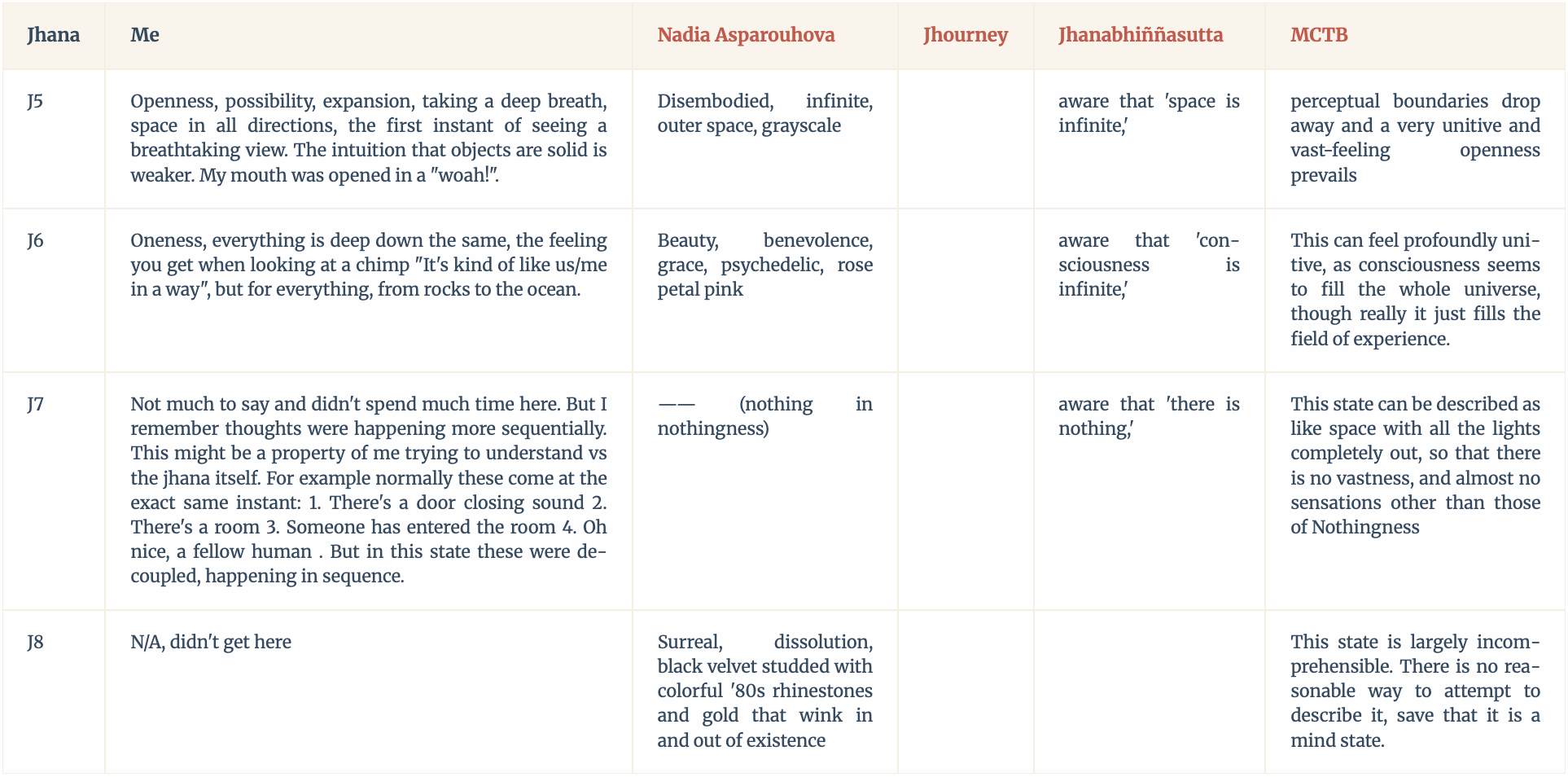
The next four categories of jhanic experience (J5 to J8) are less emotional, and their prominent defining qualities are more about quirks in how our experience gets rendered, especially aspects like our sense of space.
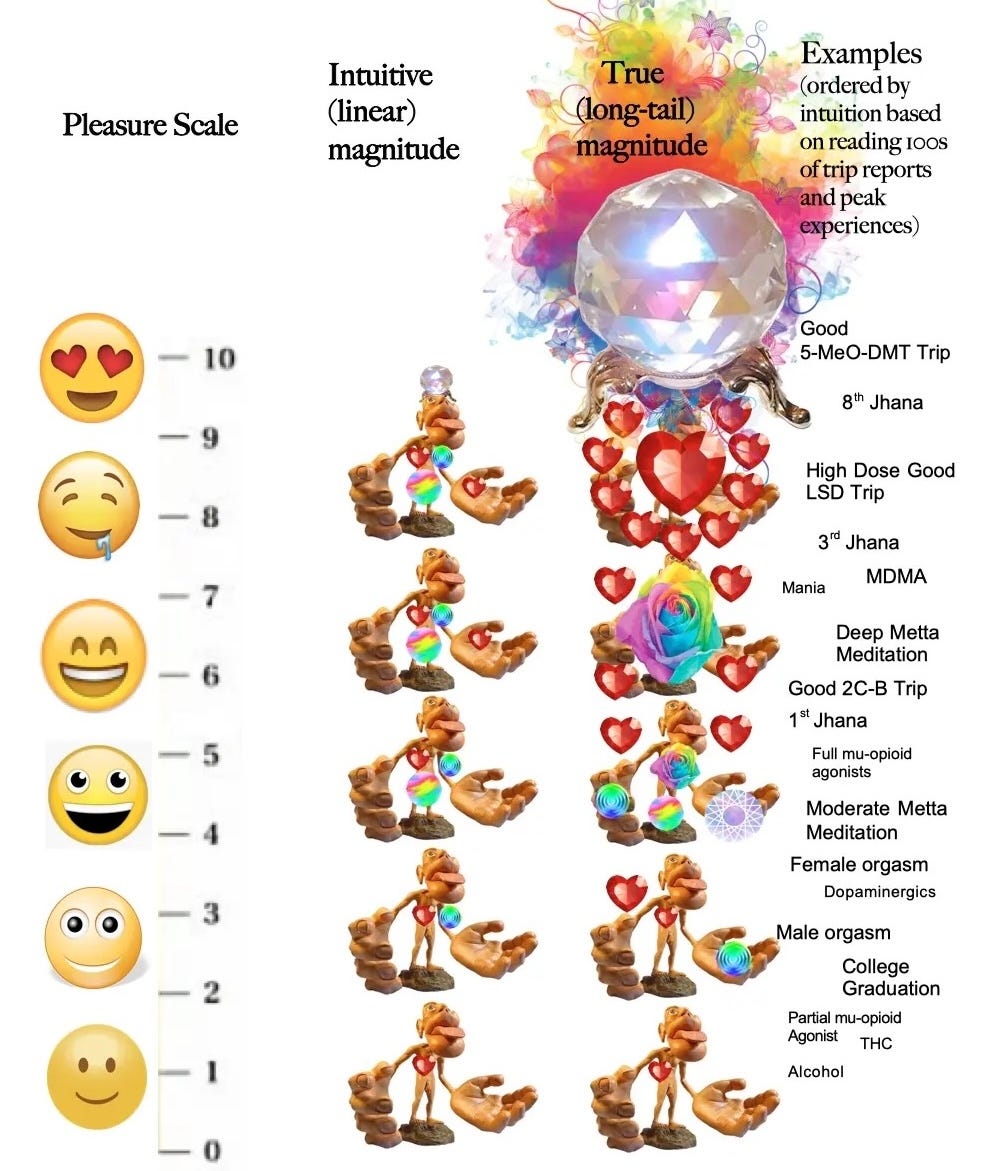
I also wanted to include the following diagram (below) which puts into perspective how good things can feel. Don’t think of it as strictly accurate, but I do think it does a good job at illustrating that the range of positive valence is vast and spans many orders of magnitude (i.e. the fact that we can feel not just 10% better or 100% better, but like 100x better), which is generally consensus among advanced meditators.
Another surprise is that jhanas are basically completely non-addictive?!
There’s many accounts of meditators literally forgetting they have this skill, or just having no desire to do it. Despite being profoundly outlier positive experiences, jhanas generally just don’t really mess with our value system; we don’t get addicted to them and narrow out everything else in our life.
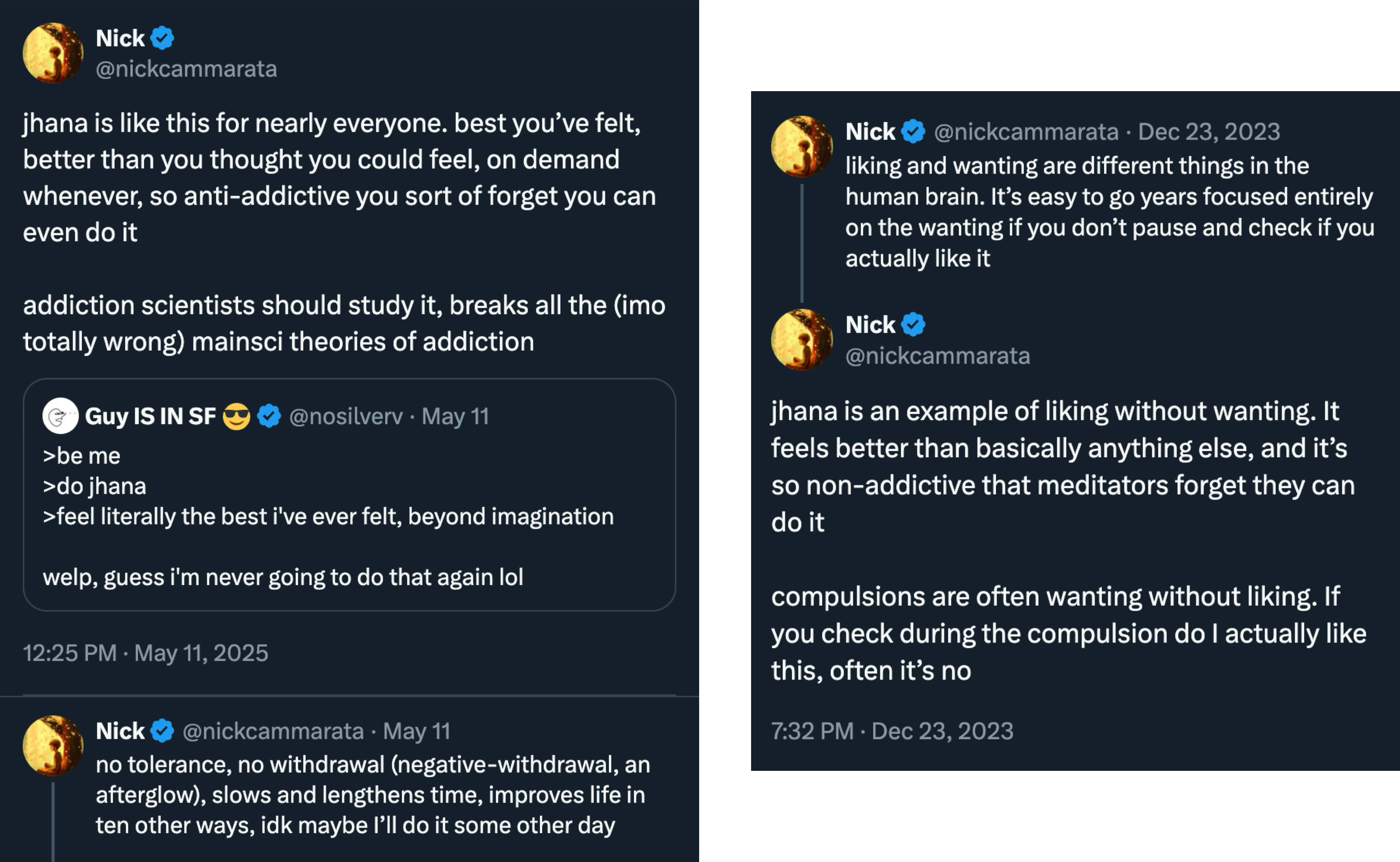
If anything, jhanas actually do the opposite of addiction, helping us cultivate equanimity and open up to life in more nourishing ways. This might seem really strange! How can better-than-MDMA experiences be non-addictive?
Maybe one good analogy is being thirsty for water! A lot of us walk around chronically parched for joy, pleasure, contentment — and if you’re that thirsty (or if water is generally scarce), then your whole motivational system orients around finding the next drink. (And if you see most people like this, you might even conclude that humans are water-maximizers!) But once you have reliable access to a faucet with surplus water, you just drink when you’re thirsty, and then go do other things. You might usually even forget the faucet is there.
Jhanas and happiness seem to work the same way. Just like we aren’t actually water-maximizers, we also aren’t actually pleasure-maximizers! Practitioners consistently report that having reliable access to surplus profound joy doesn’t make them chase it harder, but actually does the opposite. They literally forget they even have this skill. The desperate edge comes off, we develop more equanimity, etc!
Apparently, we can teach this skill pretty quickly?
Or, at least, it’s a lot more tractable than people usually think, and we’re observing that it doesn’t take many years of practicing like a monk.
First, let me take a small detour: In general, we already have many examples of how really good pedagogy/metalearning allows us to learn way faster than usual. Not just 10% or 50% faster, but more like 10-100x faster, getting to a basic level of fluency within a few days or weeks, rather than a few years. One example I like is how Betty Edwards teaches drawing. The premise of her pedagogical method is that drawing can be broken down into a set of certain perceptual skills. She’s isolated the specific micro mental muscles that seem to fundamentally contribute to the overarching skill of drawing. Then, she makes students do exercises that she designed to activate those specific fundamental micro mental muscles (kinda like wiggling your ear for the first time). It turns out that this kind of pedagogy is robust enough to make confused/untalented beginners progress really fast5, getting to a kind of fluency that usually takes years otherwise. The below screenshot shows self-portraits drawn before and after a 5-day workshop (30-40 hours of instruction and practice).

Conveniently, it just turns out that we can do a very similar thing with the skill of self-induced happiness feedback loops (jhanas).
There’s this team of people (Jhourney) who wanted to see how fast the jhanas could be taught. So, they found some really advanced meditators and took lots of measurements (incidentally creating the world’s largest EEG dataset for advanced meditative states), because they wanted to try creating an effective neuro-feedback loop that might help beginners learn the jhanas. Surprisingly, it turns out the neurotech wasn’t even needed for massive improvements in learning speed! They’re seeing reasonable success in teaching the jhanas to novice meditators in under a week, without neurotech, just from improvements in pedagogy and metalearning.6
For some more public resources on jhanas, check this footnote.7
And, for some more nuances, check this footnote.8
But jhanas are only temporary!
They’re profoundly positive, but they’re temporary, so why is this good for us? Well, first of all, we’ve seen that they’re quite a scenic adventure with some reproducibly profound effects! That’s cool already.
But more importantly, how does this lead to lasting improvements towards profound baseline wellbeing??? Well, it turns out that jhanic experiences are one of the things that create really great conditions for investigating the micro-mechanics of suffering/happiness!
This is really cool; it’s not a trivial result! In fact, it’s exactly one of the main things that the Buddha’s innovation was about!
It seems like people knew about the happiness-feedback-loops (jhanas) long before the Buddha guy, and people were practicing them for the various cool side effects. The Buddha guy comes along and he starts autistically obsessing about how to solve suffering, so he leaves home and he goes to a couple well-known teachers, and it turns out he’s a prodigy at this meditation stuff, but he’s like, “Wait, it’s not actually solving my suffering/happiness.” He does a lot of quirky, careful experiments on himself (kinda like Bryan Johnson but for happiness) and goes through a whole adventure, then eventually he was like, “Ohhh, jhanas can help us look closely (i.e. quiet the mind + gain high sensory clarity), and it turns out that if we look really closely, we notice some certain strange quirks about how the mind works, one of which is that a certain subtle mental motion seems to generate all our suffering, and we can eventually stop doing it which allows us to feel really good all the time!”
So that’s what the next blog post will be about!
One small example is that many Anthropic staff members have gone on a “jhana” retreat.
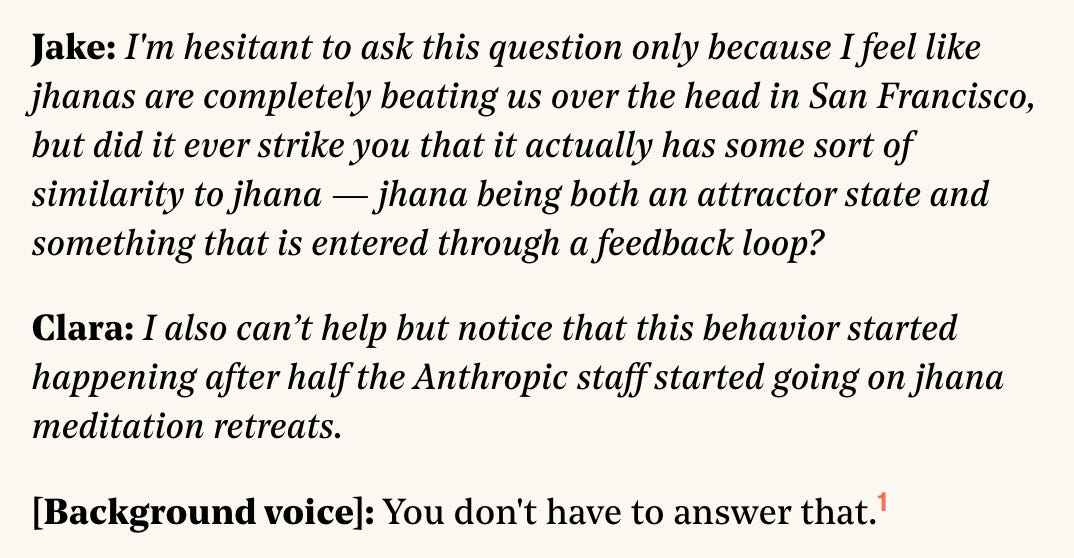
It turns out it’s just a Pali word that basically literally translates to “meditation.” In these contexts, the word is more commonly used to refer to some specific meditative experiences.
Yes, actually spend 10-90 minutes doing that! Explaining this in detail is sorta beyond the scope of this blog post, but I’ll gladly recommend the books No Bad Parts by Richard Schwartz and Focusing by Eugene Gendlin! These are often recommended in the meditator community, because they seem to be exceptionally effective for untangling personal blocks or issues, compared to the usual therapy modalities like CBT, etc.
One meditator with several thousand hours of experience says:
most people I know who made the most progress in meditation report 1. I did a bunch of meditation, it went fine 2. I did a bunch of therapy I thought was unrelated 3. Mediation started working wayyy better after, transformative, all the things that barely worked now really worked
none of them expected this, were surprised by it, and afaict happened independently. this was basically my path as well btw. also starting around 3 meditation and therapy starts to blur ime, it’s about releasing contractions, many methods of doing that
In the past few years, we’ve even been getting several neuroimaging studies on this phenomenon from the Meditation Research Program at Harvard Medical School and Massachusetts General Hospital! You can get PDFs of their publications from their website.
Emphasis on confused and untalented beginners!! Yes, there are many other people who progress really fast without following these exercises. However, I’m not trying to talk about talented drawers, I’m trying to talk about the kind of people who tried drawing and gave up because they thought it just wasn’t for them. I want the pedagogy/metalearning litmus test to be something like, “Do we have a method to deterministically/reproducibly/robustly get the most confused, most untalented beginners to develop fluency?”
Here’s some data on that: https://nadia.xyz/meditation-experience.
And here’s some elaboration: https://gwern.net/doc/psychiatry/meditation/2024-asparouhova.pdf
Here are some resources from Owen, who helped facilitate several retreats with the Jhourney team: [how to jhana in 500 words], [on forgiveness meditation], [on prerequisite enjoyment], [jhana bottlenecks / skill tree], [on breath], [on nice feelings and not-nice feelings]
Nadia Asparouhova wrote a small DIY guide. Guy wrote a blog post on jhana FAQs. Jake Eaton wrote a detailed report of his Jhourney retreat. José Luis Ricón Fernández de la Puente also wrote a detailed report of his Jhourney retreat. Rob Burbea led a jhana retreat (audio; transcripts). Richard Ludlow compiled some resources in a Twitter thread. Jhourney-style jhana practice is largely inspired by TWIM.
Here are some articles: Asterisk, Vox, Time.
It’s also fun to watch Jhourney’s post-retreat interviews with students.
(a) It’s good to note that jhanas fit into the category of meditative practices called “concentration meditation.” The other category is “insight meditation” (the thing I previewed at the end of this post, which I’ll explain in the next post). Here’s a further commentary on those categories and how they fit together.
(b) There actually seems to be two depths of jhana that practitioners talk about, kinda. They’re often called “hard” jhanas vs “soft” or “lite” jhanas. Hard jhanas are characterized by incredibly deep collectedness (aka absorption, concentration) where you might lose awareness of your body/surroundings entirely, even in the earlier jhanas. Soft jhanas are less intense and more accessible (you retain some awareness of your body/surroundings) but are still distinct and profoundly positive.
(c) Relatedly, there are two main schools of thought on how to enter jhanas. One approach emphasizes concentration, requiring laser-focus on a single object (like the breath) until absorption naturally occurs (I’m oversimplifying a bit). The other approach is what we described in this post; it’s softer and more relaxed, with more open awareness, emphasizing pleasure and enjoyment as the doorway. The second approach tends to be much more accessible for modern practitioners.
(d) There’s some debate between traditions on what’s a “real jhana” and here’s some commentary on that, but I don’t think it’s too important for our discussion here. The good news is that even soft/lite jhanas are able to create good conditions for insight meditation.
Banger post
One framing I really like from Cate Hall's recent piece
Addiction is wanting without liking.
The opposite of addiction would then be what...
Enlightenment is liking without wanting.
as someone currently in the ai research space in the bay, oh my goodness i’m so glad to have stumbled open your page!! i didn’t realize how widespread this topic was, look forward to hearing more.